In Defense of Decaf
The author defends decaffeinated coffee and discusses the major methods for removing caffeine from beans.
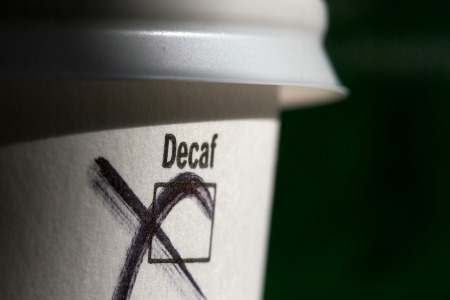
Photo by zoonabar/Flickr CC
Many of the more macho coffee drinkers think that all decaffeinated coffee is beside the point. "Why bother?" they ask.
But those who value the taste of coffee as well as the stimulation may disagree. Then, there are those people who, despite their love and appreciation of coffee, can't tolerate much caffeine; others, who tolerate it well in the early part of the day, can't sleep if they drink coffee later in the day. Caffeine metabolism varies widely among individuals. Generally, men process caffeine faster than women, especially pregnant women, who are slowest. The liver metabolizes caffeine, so age and liver health also affect one's tolerance. (See "Caffeine and Decaf" in the curator's Joy of Coffee , or the Wikipedia entry on caffeine.)
All this brings us to decaffeinated coffee.
As recently as the mid-'80s, people were drinking more decaf, thinking that caffeine was bad for them. As more and more research showed the health benefits of coffee, people began to switch back to caffeine. Sales of decaf in the late '80s for some roasters were as high as 25 percent of total coffee sales. Today, among both commercial and specialty roasters, the percentage is more like 10 to 15: lower, but still a significant portion of coffee drinking.
Please suspend any chemo-phobia you may have while reading this. Don't let the technical words for chemicals put you off, and don't play into the hands of the irresponsible scare tactics of unscrupulous advertisers of Swiss Water-process decaffeination.
There are four main methods of decaffeination in wide use today, each named for the solvent used: di-hydro-oxide (aka water), ethyl acetate, supercritical CO2, and methylene chloride (dichloromethane in Europe). Even if you remember your high school chemistry, the words may be unfamiliar, but keep that chemo-phobia in check. (A new method using ultraviolet light is coming to the market. Don't get your hopes up--poor flavor, so far.)
All methods produce a range of quality primarily due to bean selection (garbage in = garbage out) and process temperature, which affects the speed and thus the cost of processing. The American standard for decaffeinated coffee is to remove 97 percent of the original caffeine. Since caffeine content of individual coffees varies widely (see my earlier post on the topic), the amount of residual caffeine will also vary. Unfortunately, all decaffeination methods adversely affect flavor, but careful selection of green beans along with competent roasting and brewing can produce a cup that may fool the experts.
For decades, we have preferred coffees decaffeinated with methylene chloride (MC) because time after time, year after year, they have produced the most flavorful cup. The method is simple enough. First, steam swells the beans to make it easier for the caffeine to be removed. The solvent is then circulated through the beans and then into distillation to remove the caffeine and wax that have been removed from the beans. The cleansed solvent is recirculated and re-distilled until the caffeine has been removed. The beans are then rinsed with water and vacuum-dried.
The most sensitive test for detecting residual MC detects as little as one part per million. I have never seen a test result that detects any amount in specialty decaf. Furthermore, the boiling point of the solvent is 104 degrees F and coffee is roasted at 375 to 425 degrees F. Any remaining solvent, if there were any, would be vaporized during roasting. MC has been eliminated from cosmetics and has stringent worker safety regulations in Europe, but the procedures used in coffee processing and roasting leave nothing to cause any concern.
Most important, after safety, is taste. MC is the most selective solvent, leaving the greatest coffee flavor in the beans.
NEXT :
PAGES :
ethyl acetate or carbon dioxide (CO2). Neither method has consistently produced satisfying flavor in the cup. Ethyl acetate, a synthetic fruit ester, leaves a fruity aftertaste in the coffee--unfortunately nothing like the berry and citrus flavors we find in East African coffees. And we had high hopes for the CO2 process in the early '90s. Carbon dioxide is the carbonation in sparkling water, but it is forced into the coffee at pressures well in excess of 1000 pounds per square inch to extract the caffeine. Perhaps it's the pressure that also forces out the coffee flavor.
The last method to discuss is dihydro-oxide --water. At one time, water process was the most damaging to coffee flavor. That general statement is no longer true, due to improvements in the processing by some companies. Although some water-process decaf has flavor approaching methylene chloride (and a relatively new North American company is making great strides in cup quality), further development will be required before it can be methylene chloride's equal.
In general the process uses water as the solvent, supersaturated with soluble solids from green coffee beans, except caffeine. The idea is that when the warm solvent is circulated through the coffee, it will extract only caffeine, which in turn is removed from the circulating fluid with activated carbon. It's a thesis that in practice has not produced great cups of decaf.
The old standby water decaffeination company, Swiss Water (the only attempt to brand a process), of Vancouver, Canada, is doing all the advertising while others are improving their process. We prefer the cup quality of other companies, and I deplore the marketing tactics of Swiss Water.
In the late '80s, when I first wrote to the previous owners, I decried their deliberately misleading advertising. Here they go again. They are falling back into advertising tactics that assume the ignorance of the audience. Their attempt to associate the chemical names of the other processes with some chemo-hysteria is unethical.
To summarize, of the four major processes for decaf, only methylene chloride and water are widely used in specialty coffee (here, by the way, Wikipedia on decaffeination is less strong than it is on caffeine). Methylene chloride can produce the best cup results when good coffee and careful processing are used. Good coffee and careful processing also produce the best results from dihydro-oxide, but the best is still second in cup quality to MC.
PAGES :